

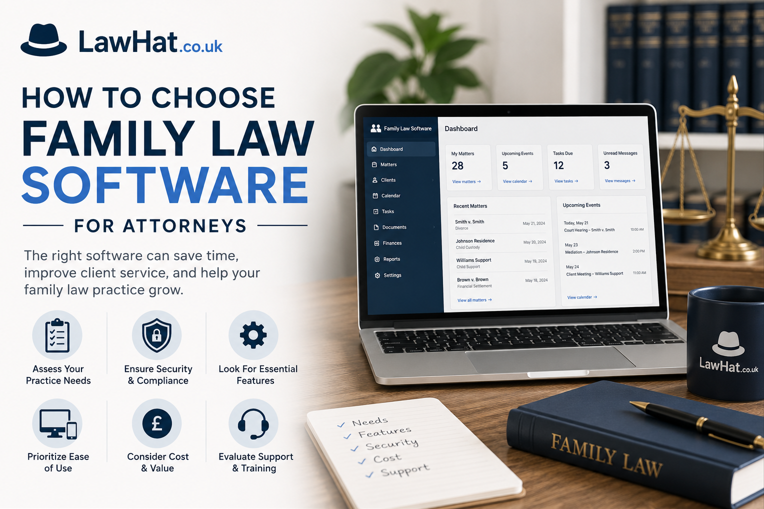
Family law involves constant updates, sensitive data, and tight deadlines. The wrong system makes everything harder than it needs to be. However, family law software solves these challenges by bringing emails, spreadsheets, and notes into a single system. It connects case filings, custody details, financial records, and client communication in one place.
A universal truth is that not every tool is built for family law. So, when choosing the right solution, you need to understand how your practice works and what the software should support. This guide explains how to choose family law software, what features to look for, and what to avoid, so you can make a confident and well-informed decision for your practice.
Content Hints
Key Features To Look For In Family Law Software
When choosing family law software, it is important to assess how well its features support your daily legal work. Some key features to consider include:
Child Support & Alimony Calculators[ES1]
These tools provide built-in calculators that compute child support and spousal support using jurisdiction-specific formulas and financial inputs. Professionals can choose from different calculation methods and generate clear worksheets that show how results are calculated.
Property Division Tools[ES2]
These tools help attorneys evaluate and divide marital assets and liabilities between parties. They can calculate distributions based on set targets like 50/50 or custom splits and include tax considerations to reflect real financial outcomes.
State-Specific Family Court Form Auto-Population[ES3]
Family law software can automatically generate court-required documents by auto-filling forms with client data. For example, financial affidavit forms collect client details and automatically populate mandatory state-specific court documents, reducing manual work and errors.
Custody Scheduling & Parenting Plan Management[ES4]
These tools help legal professionals and parents create and manage custody arrangements. They track parenting time, including holidays and special events, and calculate time distribution between parents.
Divorce-Specific Financial Analysis & Projections
With these features, family law tools help evaluate income, expenses, assets, liabilities, and tax impact to give a complete financial picture. They also generate long-term projections for cash flow and net worth, and settlement outcomes, helping assess financial sustainability, compare scenarios, and support informed decision-making during divorce proceedings.
Benefits Of Using The Right Family Law Software
Legal technology is transforming law firm operations, including family law. According to Clio’s 2024 Legal Trends Report[SK5] , AI use among legal professionals rose from 19% in 2023 to 79% in 2024. [ES6] Lawyers using AI report time savings and efficiency gains (54%)[ES7] , improved work quality (36%)[ES8] , and better caseload management (36%)[ES9] .
These benefits are especially important in family law, where financial complexity, emotional pressure, and strict deadlines intersect. When attorneys use purpose-built software rather than generic tools, these benefits multiply through accuracy controls tailored for divorce, custody, and support issues. More benefits include:
Stronger Evidentiary Foundation In Contested Proceedings
When the other side questions financial figures or parenting plans, family law platforms provide a clear audit trail. In these tools, every calculation links back to its inputs, applied method, and jurisdiction-specific rules. As a result, attorneys can reconstruct the results step by step, making it harder for the opposing party to dispute the numbers in court.
Faster, More Confident Settlement Negotiations
Using family law software, attorneys can test multiple outcome scenarios during negotiations. These solutions also allow both parties to view the financial impact of changes in real time. As a result, discussions move faster, reduce unnecessary back-and-forth, and often lead to quicker resolutions with lower client costs.
Reduced Exposure To Malpractice Claims From Miscalculation
Errors in support figures, tax treatment, or asset valuation can create legal risk long after a case ends. To reduce this risk, these platforms apply statutory formulas and flag missing inputs before generating results. These controls create a reliable record that shows the correct method was applied at the time of advice.
Improved Client Comprehension And Decision-Making
Clients often struggle to understand financial outcomes and custody arrangements. Family law software presents this information through brief summaries and structured worksheets. Using these outputs, clients can see how figures are calculated, what their future finances may look like, and how different custody plans affect their time. With this level of clarity, they can make more informed decisions.
Tips For Choosing The Right Software[ES10]
Not all family law solutions serve every practice equally well, so choosing a family attorney software is a strategic decision. The right solution should support your firm’s growth, reduce administrative strain, and create a better client experience for years to come. To make that choice with confidence, consider the following tips:
Assess Your Firm’s Specific Workflows First
Before evaluating any software, identify the burdensome tasks of your practice. Think about the workflows that cause the most strain, the features you cannot do without, and how the software will help you maintain clear communication with clients. A clear picture of your pain points prevents you from paying for tools you will never use while missing the ones you actually need.
Match The Solution To Your Firm’s Size And Resources
Every firm has different needs based on team size, caseload, and financial resources. A solo practitioner, for example, may need an affordable solution with strong billing and communication tools, while larger firms might prioritize scalability, training support, and robust reporting. So, software should be evaluated with your firm’s current structure in mind to ensure faster adoption and a better return on investment.
Test Before You Commit
Do not just take the vendor’s word for it; test out the software yourself to see if it meets your needs. Many vendors offer free trials or demos, so take advantage of these opportunities to get a feel for the product. Involve the staff who will use it daily, not just firm leadership, since front-end usability issues are often discovered during hands-on testing rather than sales presentations.
Verify Integration Compatibility With Existing Tools
If you use other legal tools, ensure the family law software you choose is compatible and integrates seamlessly with them. Otherwise, poor integration can bring back the same errors and inefficiencies the software was meant to eliminate.
Prioritize Vendors That Offer Ongoing Support And Updates
Family law statutes, support formulas, and court form requirements change regularly across jurisdictions. So, you should look for a vendor that offers comprehensive support and training resources, along with regular updates to keep the software aligned with evolving laws and regulations. Remember, a dated platform creates compliance risks, regardless of how well it performed at the time of purchase.
Confirm Mobile Access And Cloud Availability
Since family attorneys spend much of their time in courtrooms and settlement conferences, it’s important to choose software with strong mobile compatibility. Such software ensures seamless access to important documents and information on the go without compromising user experience.
Ultimately, the best family law software for attorneys and legal practices is not the one with the most features; it is the one your team will actually use, trust, and grow with. So, take the time to evaluate options carefully before you commit. You will face fewer disruptions later and build a stronger foundation for every case that follows.
Common Mistakes That You Must Avoid[ES11]
Even experienced attorneys can make avoidable errors when they select software for their practice. When you know what to watch out for, the evaluation process becomes considerably sharper. Avoid these common mistakes:
- Choosing Features Over Fit: Vendors offer extensive features, but many tools fail to align with your practice. This results in software that does not effectively support your specific workflows.
- Underestimating the True Cost: Costs extend beyond pricing to include training, onboarding, and transition delays. Low-cost tools often become expensive due to add-ons and implementation challenges.
- Mismatch With Firm Size: Large platforms overwhelm small teams, while limited tools restrict growing firms. Both cases lead to inefficiencies and reliance on manual workarounds.
- Skipping Staff Input: Lack of team involvement reduces adoption. When training is unstructured, only a few users understand the system, limiting its practical value.
- Ignoring Integration Needs: Poor integration forces manual data transfer between systems, leading to errors, wasted time, and disconnected workflows across the firm.
- Overlooking Jurisdiction Updates: Software without regular legal updates risks non-compliance. Outdated rules and missed deadlines can turn the system into a liability rather than protection.
To avoid these mistakes, you do not need a lengthy procurement process; you only need to ask the right questions early. Firms that succeed first identify where time is lost, where errors occur, and where clients feel disconnected, then they evaluate usability as carefully as features.
Popular Family Law Software Options You Must Explore
Several platforms are commonly used in legal practices and offer features relevant to family law, for example:
- Clio
- MyCase
- Smokeball
- CosmoLex
- Rocket Matter
- PracticePanther
- LEAP Legal Software
Each platform provides a combination of case management, billing, and communication tools. So, you must evaluate each of them based on your specific requirements to identify the best fit.
Final Thoughts
Choosing the right legal software requires careful evaluation rather than a quick decision. The goal is to select a tool that aligns with your case handling, document management, and client communication.
A well-chosen solution improves organization, reduces manual effort, and supports consistent case management. Over time, this leads to better efficiency and excellent client experiences.