

Learn the difference between DWI and DUI, their legal meanings, penalties, and how laws vary across states.
Driving under the influence of alcohol or drugs is a serious offense that can result in severe legal consequences. However, many people are confused by the terms DUI and DWI. While both relate to impaired driving, they do not always mean the same thing. The exact difference depends on the laws of the state where the offense occurs.
Understanding the distinction between DUI and DWI is important because the penalties, charges, and long-term consequences may vary. This article explains the meaning of each term, highlights their differences, and provides a clear comparison to help you better understand these common traffic offenses.
Content Hints
What Is a DUI?
DUI stands for Driving Under the Influence. A person may be charged with a DUI when they operate a vehicle while impaired by alcohol, illegal drugs, prescription medications, or other substances that affect their ability to drive safely.
In many states, a DUI charge can be issued even if a driver’s blood alcohol concentration (BAC) is below the legal limit, provided law enforcement can demonstrate that the driver’s ability to operate the vehicle was impaired.
Common signs of impairment include:
- Slurred speech
- Poor coordination
- Erratic driving
- Delayed reaction times
- Failure of field sobriety tests
A DUI conviction can lead to fines, license suspension, mandatory education programs, and even jail time.
What Is a DWI?
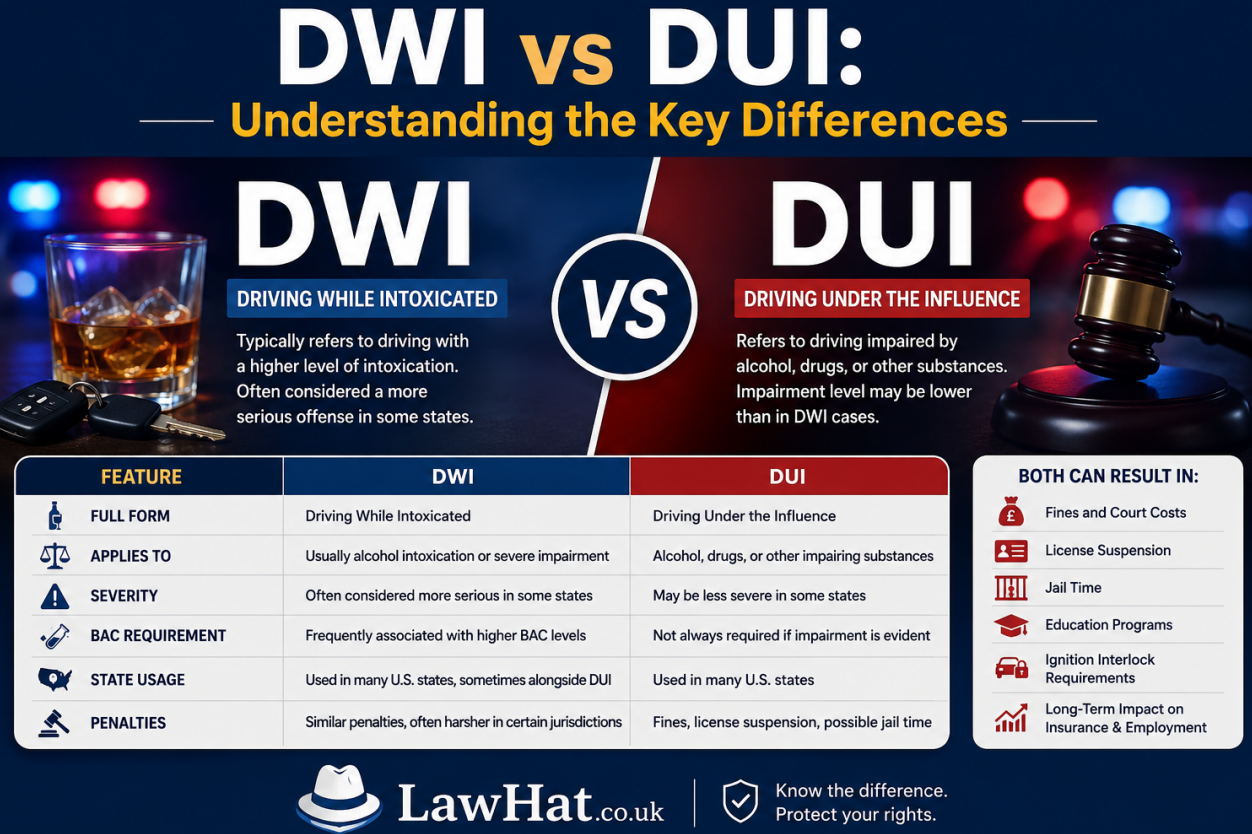
DWI typically stands for Driving While Intoxicated or Driving While Impaired, depending on the state. In some jurisdictions, DWI is considered a more serious offense than DUI because it may indicate a higher level of intoxication.
For example, a driver with a BAC significantly above the legal limit may face a DWI charge rather than a DUI charge. However, the interpretation varies widely across states.
Some states use only the term DUI, some use only DWI, and others use both terms with different meanings.
DWI vs DUI: Quick Comparison
| Feature | DUI | DWI |
| Full Form | Driving Under the Influence | Driving While Intoxicated/Impaired |
| Applies To | Alcohol, drugs, or other impairing substances | Usually alcohol intoxication or severe impairment |
| Severity | May be less severe in some states | Often considered more serious in some states |
| BAC Requirement | Not always required if impairment is evident | Frequently associated with higher BAC levels |
| State Usage | Used in many U.S. states | Used in many U.S. states, sometimes alongside DUI |
| Penalties | Fines, license suspension, possible jail time | Similar penalties, often harsher in certain jurisdictions |
How States Define DUI and DWI
One reason for confusion is that there is no nationwide definition of DUI and DWI. Each state establishes its own laws.
States That Use DUI Only
Some states use only the term DUI to describe impaired driving offenses. Regardless of whether alcohol or drugs are involved, the charge is generally classified as a DUI.
States That Use DWI Only
Other states use only DWI. In these jurisdictions, DWI serves as the primary offense for driving while impaired.
States That Use Both Terms
Certain states distinguish between DUI and DWI. In these states:
- DUI may refer to a lower level of impairment.
- DWI may refer to a higher BAC or more serious intoxication.
- Different penalties may apply depending on the charge.
Because laws vary, individuals should review the specific regulations in their state.
Legal Blood Alcohol Concentration Limits
In most U.S. states, the legal BAC limit for drivers aged 21 and older is 0.08%.
However, stricter standards often apply to:
- Commercial drivers
- Drivers under the legal drinking age
- Repeat offenders
Even if a driver’s BAC is below the legal limit, they may still face charges if their driving ability is noticeably impaired.
Common Penalties for DUI and DWI
The consequences of a DUI or DWI conviction can be significant. Penalties often depend on factors such as BAC level, prior offenses, and whether an accident occurred.
Common penalties include:
Fines
Offenders may be required to pay hundreds or thousands of dollars in fines, court fees, and related costs.
License Suspension
Many jurisdictions suspend or revoke driving privileges after a DUI or DWI conviction.
Jail Time
Serious offenses, repeat violations, or accidents involving injuries may result in imprisonment.
Probation
Courts may place offenders under supervision and require compliance with specific conditions.
Alcohol Education Programs
Mandatory substance abuse education or treatment programs are common sentencing requirements.
Ignition Interlock Devices
Some offenders must install a device that prevents a vehicle from starting if alcohol is detected on the driver’s breath.
DUI and DWI Involving Drugs
Alcohol is not the only substance that can lead to impaired driving charges. Drivers can also face DUI or DWI charges for operating a vehicle under the influence of:
- Illegal drugs
- Prescription medications
- Over-the-counter medications
- Marijuana where impairment is evident
Law enforcement officers may use field sobriety tests, drug recognition experts, and chemical testing to determine impairment.
Long-Term Consequences
A DUI or DWI conviction can affect more than just driving privileges.
Potential long-term consequences include:
- Increased insurance premiums
- Employment difficulties
- Professional licensing issues
- Travel restrictions to certain countries
- Permanent criminal record in some cases
Because of these impacts, many individuals seek legal representation when facing impaired driving charges.
Can DUI or DWI Charges Be Reduced?
In some situations, prosecutors may agree to reduce charges through plea negotiations. Factors that may influence charge reductions include:
- Lack of prior offenses
- Weak evidence
- Procedural errors
- Cooperation with law enforcement
However, outcomes vary significantly depending on the facts of each case and local laws.
Which Charge Is Worse: DUI or DWI?
There is no universal answer. In some states, DWI is considered more serious than DUI because it reflects a higher degree of impairment. In other states, the terms are interchangeable and carry similar penalties.
The severity depends on:
- State law
- BAC level
- Prior convictions
- Whether injuries or property damage occurred
- Presence of drugs or alcohol
Therefore, understanding the specific laws where the offense occurred is essential.
Conclusion
The difference between DUI and DWI depends largely on state law. Both offenses involve operating a vehicle while impaired by alcohol, drugs, or other substances, but some states use the terms differently. In jurisdictions that recognize both charges, DWI may indicate a higher level of intoxication or a more serious offense.
Regardless of the terminology, both DUI and DWI carry serious legal and financial consequences. Drivers should always avoid operating a vehicle when impaired and understand the laws that apply in their state.
Frequently Asked Questions (FAQ)
What does DUI stand for?
DUI stands for Driving Under the Influence and generally refers to operating a vehicle while impaired by alcohol or drugs.
What does DWI stand for?
DWI usually means Driving While Intoxicated or Driving While Impaired, depending on the state.
Is DWI more serious than DUI?
In some states, yes. DWI may indicate a higher level of intoxication, but the distinction varies by jurisdiction.
Can you get a DUI below the legal BAC limit?
Yes. If law enforcement can prove impairment, a DUI charge may still be possible.
Do drugs count in DUI or DWI cases?
Yes. Illegal drugs, prescription medications, and certain over-the-counter drugs can result in impaired driving charges.
Will a DUI or DWI affect insurance rates?
Yes. Insurance premiums often increase significantly after a conviction.
Can first-time offenders go to jail?
Depending on the state and circumstances, even first-time offenders may face jail time, although alternatives are sometimes available.
Are DUI and DWI federal offenses?
No. These are generally state-level offenses governed by state laws.