

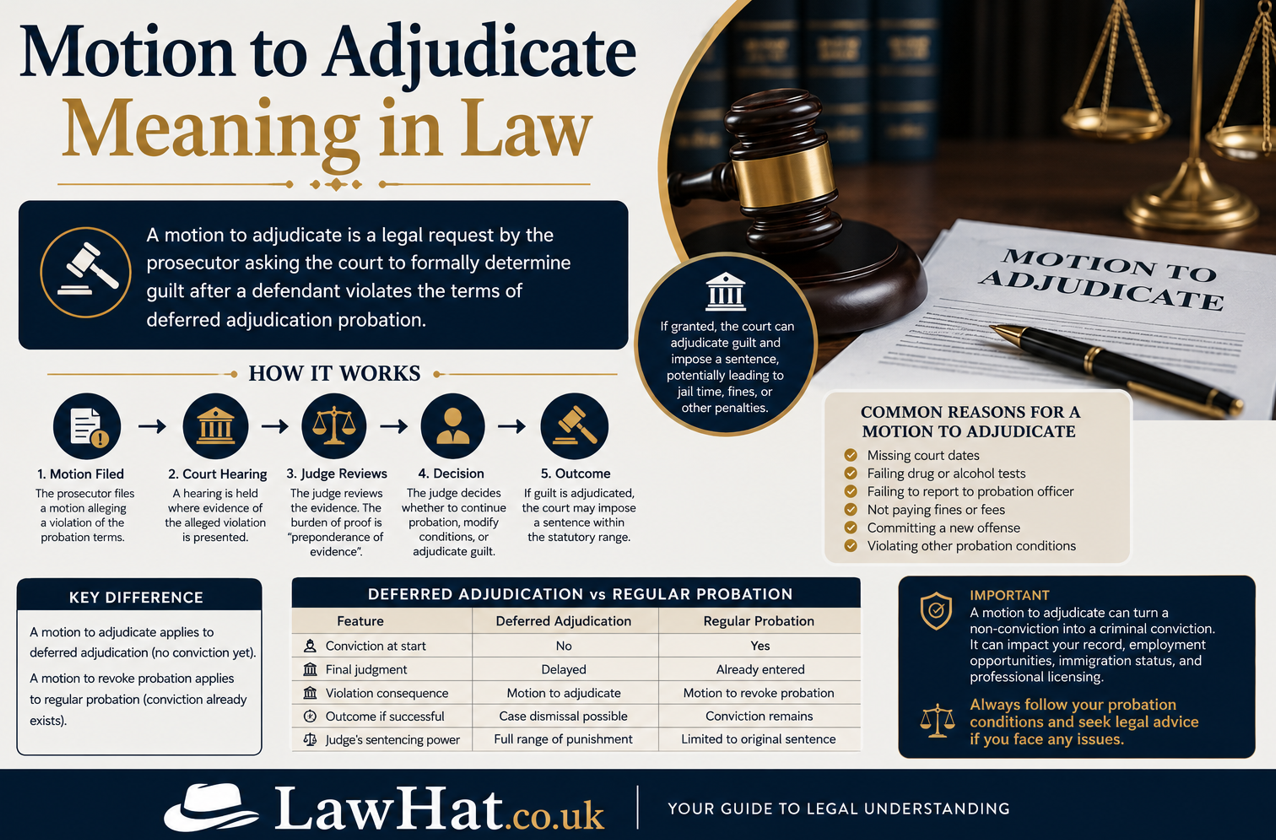
Learn what a motion to adjudicate means, how it works, and its legal impact in probation and criminal cases.
A motion to adjudicate is a legal request filed by a prosecutor asking the court to formally determine (or “adjudicate”) a defendant’s guilt after a prior period of deferred adjudication. This concept commonly appears in criminal law, especially in cases where a defendant was initially given a chance to avoid a conviction by complying with specific conditions set by the court.
Understanding the meaning and implications of a motion to adjudicate is essential for anyone dealing with probation, deferred adjudication, or criminal proceedings.
Content Hints
What Is a Motion to Adjudicate?
A motion to adjudicate is filed when a defendant who was placed on deferred adjudication probation is accused of violating the terms of that probation. Instead of immediately convicting the defendant at the time of the original plea, the court had postponed the finding of guilt.
However, if the defendant fails to comply with the probation conditions—such as missing court dates, failing drug tests, or committing another offense—the prosecution can file this motion.
In simple terms:
- Before motion: No formal conviction yet
- After motion (if granted): Court can find the defendant guilty and impose a sentence
Deferred Adjudication Explained
Deferred adjudication is a form of probation where:
- The defendant pleads guilty or no contest
- The judge delays a final judgment
- The defendant must follow strict probation conditions
If the defendant successfully completes the probation period, the case may be dismissed without a conviction. But if they violate conditions, a motion to adjudicate can be filed.
When Is a Motion to Adjudicate Filed?
A prosecutor may file this motion under several circumstances, including:
- Failure to report to a probation officer
- Missing court appearances
- Failure to pay fines or fees
- Positive drug or alcohol tests
- Committing a new crime
Even minor violations can trigger this motion, depending on the case and jurisdiction.
Legal Process After Filing
Once a motion to adjudicate is filed, the legal process typically includes:
Arrest or Court Summons
The defendant may be arrested or ordered to appear in court.
Hearing
A hearing is held where the judge reviews evidence of the alleged violations.
Burden of Proof
The burden of proof is lower than in a criminal trial. The prosecution must show that the violation is more likely than not (preponderance of evidence).
Judge’s Decision
The judge may:
- Continue probation
- Modify conditions
- Adjudicate guilt and impose a sentence
Possible Outcomes
The consequences of a motion to adjudicate can be serious:
- Adjudication of guilt (formal conviction)
- Jail or prison sentence
- Extended probation
- Additional fines or penalties
Unlike regular probation violations, judges often have broader discretion in deferred adjudication cases.
Key Differences: Deferred vs Regular Probation
| Feature | Deferred Adjudication | Regular Probation |
| Conviction at start | No | Yes |
| Final judgment | Delayed | Already entered |
| Violation consequence | Motion to adjudicate | Motion to revoke probation |
| Outcome if successful | Case dismissal possible | Conviction remains |
| Judge’s sentencing power | Full range of punishment | Limited to original sentence |
Why Is It Important?
A motion to adjudicate is significant because it can transform a case from a non-conviction status into a full criminal conviction. This can affect:
- Employment opportunities
- Criminal record
- Immigration status
- Professional licensing
For many defendants, avoiding adjudication is critical to maintaining a clean record.
Defense Strategies
If facing a motion to adjudicate, defendants may use several legal strategies:
- Challenging the evidence of violation
- Demonstrating compliance with conditions
- Providing valid reasons (e.g., medical emergency)
- Negotiating with prosecutors
Legal representation is crucial in these situations because the stakes are high.
Common Misconceptions
“Deferred adjudication means no consequences.”
Not true. Violations can lead to serious penalties.
“Minor violations don’t matter.”
Even small infractions can result in a motion being filed.
“The judge must be lenient.”
Judges have wide discretion and may impose severe penalties.
Real-World Example
Imagine a defendant charged with a non-violent offense. The court grants deferred adjudication with conditions such as:
- Monthly check-ins
- Drug testing
- Community service
If the defendant fails a drug test, the prosecutor may file a motion to adjudicate. At the hearing, the judge may then find the defendant guilty and impose a sentence, such as jail time.
How to Avoid a Motion to Adjudicate
To reduce the risk:
- Follow all probation conditions strictly
- Maintain communication with your probation officer
- Attend all court dates
- Avoid illegal activities
- Seek legal advice if issues arise
Consistency and compliance are key.
Conclusion
A motion to adjudicate is a critical legal action that can significantly change the outcome of a criminal case. It serves as a mechanism for courts to enforce compliance with deferred adjudication conditions and ensure accountability.
Understanding its meaning, process, and consequences can help individuals make informed decisions and avoid severe legal repercussions. Whether you are directly involved in a case or simply seeking knowledge, recognizing the importance of this motion is essential in navigating the legal system.
FAQ
What does a motion to adjudicate mean?
It is a request by the prosecutor asking the court to determine guilt after a defendant violates deferred adjudication probation.
Is a motion to adjudicate the same as probation revocation?
No. It applies specifically to deferred adjudication, while probation revocation applies to cases with an existing conviction.
Can you go to jail after a motion to adjudicate?
Yes. If the judge adjudicates guilt, they can impose jail or prison time.
Can a motion to adjudicate be dismissed?
Yes, if the defense successfully challenges the allegations or the judge decides not to proceed with adjudication.
Does deferred adjudication stay on your record?
It may still appear on background checks, even if the case is dismissed.