

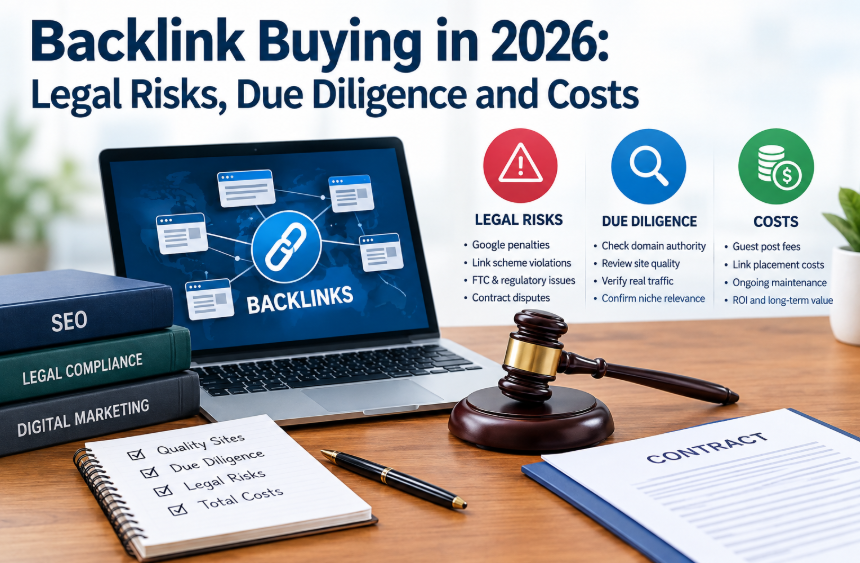
Buying a backlink is not automatically illegal in the UK, but the way a link is arranged and presented can create legal, commercial and search-visibility risks. A business considering paid links should assess more than a site’s domain metrics: it should understand what is being purchased, what the publisher promises, and whether readers could be misled. This guide looks at the practical checks behind safe backlink buying and the costs businesses may encounter in 2026.
Content Hints
Are paid backlinks against the law?
There is no general UK law that prohibits a business from paying another website to place a link. The legal issue is usually how the arrangement is carried out. A paid placement that resembles independent editorial content may mislead readers if its commercial nature is hidden. Where content is an advertisement or another form of marketing communication, advertising rules require it to be clearly identifiable as such. The precise position depends on the format, audience and circumstances.
Consumer-facing businesses should also consider the rules against unfair commercial practices. A recommendation presented as impartial when it has been bought could give consumers a misleading impression. The same concern can arise with reviews, endorsements and sponsored articles, not just links. Clear labelling such as “Sponsored” or “Advertisement” can help, but a label should be prominent enough for readers to notice before relying on the content.
Search-engine policies are a separate matter. Search providers may treat paid links intended to manipulate rankings as a policy violation and may discount them or take action against a site. That is not the same as a finding that the purchase was unlawful, but it can still cause a costly loss of traffic. A business should not confuse compliance with search guidelines with compliance with the law—or assume that one guarantees the other.
What do backlinks cost in 2026?
There is no standard tariff. As an illustrative guide, a basic placement on a small or niche website might cost around £50 to £200, while a relevant publication with an established audience may charge several hundred pounds. A prominent editorial feature on a well-known site can cost £1,000 or more. Prices vary substantially by subject, readership, editorial effort, placement, and whether the fee covers content creation as well as publication.
Very low prices can be a warning sign where a seller promises large numbers of links, guaranteed rankings or placements on sites that cannot be named in advance. High prices are not proof of quality either. Before agreeing, ask what the fee covers, whether the link will be permanent, whether the article will be labelled, and what happens if the publisher removes it. Treat claims about “authority” or ranking outcomes cautiously: no freelancer or publisher can reliably guarantee a particular search position.
Due diligence before paying
Check the proposed publisher as a real website, not just a score in an SEO tool. Look for original articles, a coherent subject area, genuine signs of readership and recent updates. Search for unrelated or repetitive sponsored posts and pages crowded with outbound links. Ask to review the actual placement and its proposed wording before it goes live. A link on a relevant site with a real audience may have a clearer business rationale than a technically impressive metric with little editorial value.
Put the arrangement in writing. The agreement should identify the deliverables, price, publication deadline, approval process, labelling, link attributes if relevant, and any removal or replacement terms. Include a clear statement that the publisher must not make unsupported claims about your products or services. Keep invoices, messages and copies of the published page; these records can help resolve disputes and show what was agreed.
If a freelancer will write or place content, confirm who owns the copy and images, and whether any third-party material is properly licensed. If the work involves collecting or using personal data—for example, contact details for outreach—make sure the parties understand their data-protection responsibilities. Outsourcing does not automatically transfer every legal obligation away from the business commissioning the work.
Choosing a freelancer or marketplace
A marketplace can make it easier to compare skills and agree a defined project, but the platform’s safeguards do not replace your own checks. For example, Osdire is a freelance marketplace with more than 900 categories, including writing, marketing, design and technology. It uses flat pricing without hidden fees and holds a buyer’s payment while an order is in progress, releasing it once the delivered work is approved. Those features can help structure a transaction; they do not certify a publisher’s quality or guarantee that a backlink is lawful or effective.
Before placing an order, agree on the exact task rather than buying a vague promise of “SEO growth.” Ask for the intended site, audience and content plan, and check that you will have an opportunity to approve the work. Avoid sellers who conceal the destination, rely on automated link networks, or refuse to explain how placements are obtained.
A measured approach
For many businesses, the safest starting point is to fund useful, accurate content and legitimate publisher relationships rather than chase a fixed number of links. Review each paid placement for transparency, relevance and contractual clarity, and assess the possible consequences if a search engine ignores it. If a campaign includes consumer endorsements or disputed claims, obtain advice suited to the specific facts. A careful process cannot remove every risk, but it can make the decision more informed and reduce avoidable legal and commercial problems.